Emery Cloth Roll: The Complete Guide for Woodworkers, Hardware Shops, and Industrial Buyers
What Is an Emery Cloth Roll, and Why Is It Different From Other Abrasives?
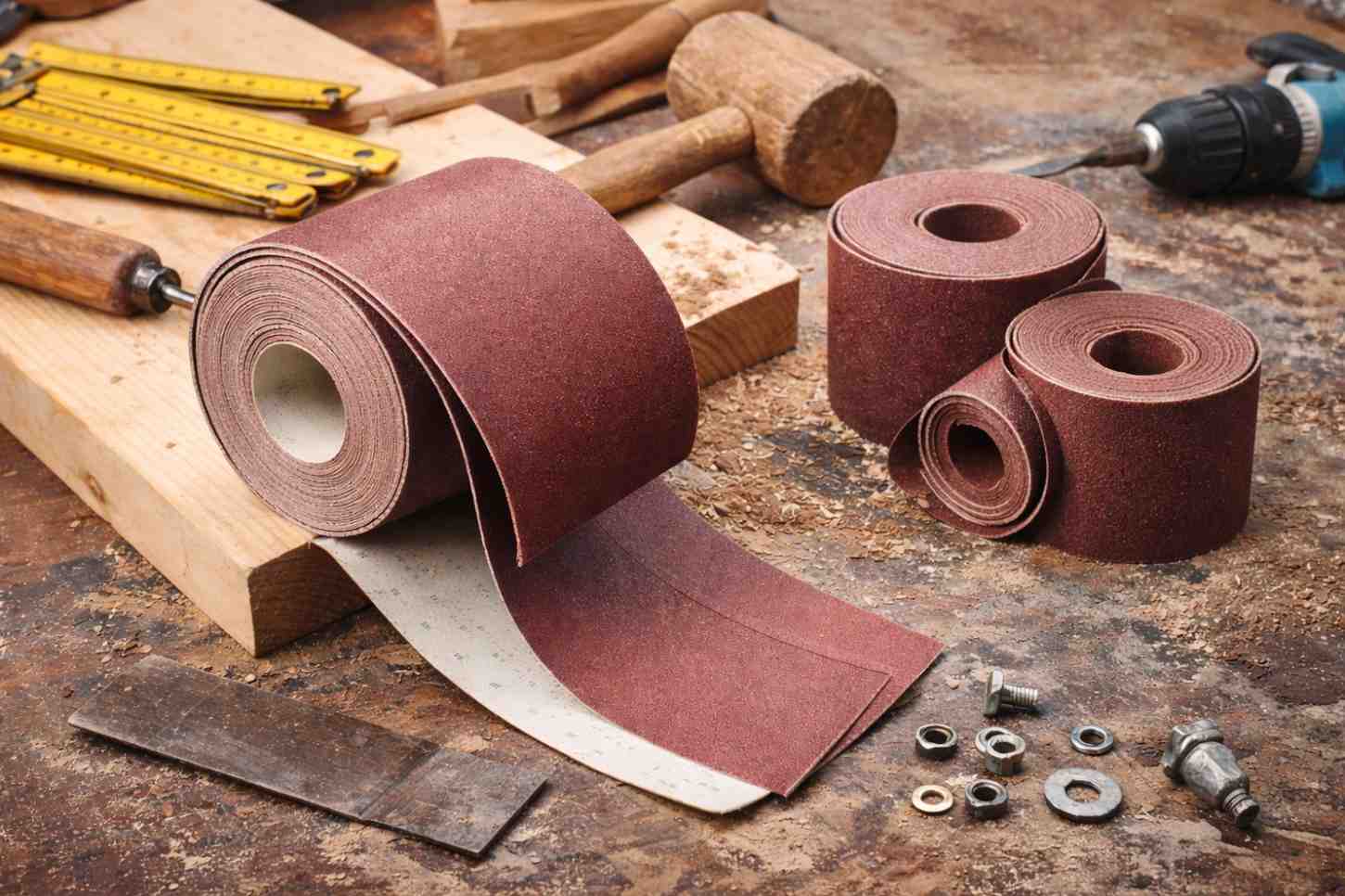
An emery cloth roll is an abrasive product made by bonding emery, a natural mineral compound of corundum and iron oxide, onto a strong, flexible cloth backing. Unlike regular sandpaper sheets, the cloth backing gives emery rolls superior flexibility, tear resistance, and durability under pressure. This makes them ideal for curved surfaces, pipes, rods, and any application where the abrasive needs to conform to the contours of the workpiece rather than lie flat against it.
The roll format itself is one of the key practical advantages. Users can cut exactly the length they need for each task, which reduces waste and improves cost efficiency compared to buying pre-cut sheets. Whether you need a 10-meter roll for a production workshop or a shorter strip for a quick finishing pass, the emery cloth roll format gives you complete control over material usage. This combination of flexible backing, tough abrasive mineral, and practical roll format is why emery cloth rolls remain one of the most consistently stocked abrasive products in hardware shops and industrial supply stores across India.
Understanding Grit Sizes: From 80 Grit to 1000 Grit
One of the most important decisions when selecting an emery cloth roll is choosing the right grit. "Grit" refers to the size of the abrasive particles embedded in the cloth; a lower grit number means larger, coarser particles that remove material aggressively, while a higher number means finer particles that produce a progressively smoother finish.
An 80-grit emery cloth roll is the go-to choice for heavy stock removal, rust removal, and cleaning up badly corroded or pitted metal surfaces. It is fast-cutting and aggressive, making it a favorite in fabrication and repair shops where speed takes priority over a refined finish. Moving up to 120 grit still offers strong material removal but produces a noticeably cleaner surface. Many woodworkers and metalworkers begin here as a practical starting point for surface preparation.
At 220 to 320 grit, the emery cloth roll transitions into intermediate finishing territory. These grits are ideal for smoothing away the scratches left behind by coarser passes and preparing the surface for paint, varnish, or coating. A 320-grit pass before applying a finish coating makes a significant difference to the final appearance and adhesion of the coating, which is something that professional finishers understand well and amateur buyers often underestimate.
600 grit and above takes the work into fine and ultra-fine finishing. A 600-grit emery cloth roll leaves a very smooth surface with minimal visible scratch marks, making it popular for polishing chrome, stainless steel, and decorative metalwork. At 1000 grit and beyond, the results approach a mirror-level finish used in precision engineering, jewelry, and high-end automotive bodywork where the final surface must be flawless. The general rule of thumb is to work progressively through grits, never skipping more than one step at a time, as deeper scratches from a coarser grit take significantly longer to remove with a fine one.
How Emery Cloth Roll Is Used in Woodworking
Woodworkers across India rely on emery cloth rolls for a wide range of finishing tasks. The flexible cloth backing is particularly well suited for sanding curved edges, routed profiles, spindles, chair legs, and any detailed work where a rigid abrasive sheet would fail to follow the shape of the surface. If you have previously used emery paper for flat surface preparation, you will find that switching to a cloth roll for curved profiles and molded sections makes the job significantly easier and produces a far more consistent result across the entire workpiece.
For general woodworking, a 120 or 150 grit emery cloth roll is a practical starting point for preparing a freshly machined or routed surface. After the first pass, moving to 220 or 320 grit removes the coarser scratches and leaves the wood ready for staining, oiling, or applying a topcoat. The key discipline in woodworking finishing is to not rush the grit progression; each step must genuinely remove the marks from the previous grit before moving up; otherwise, those scratches will show through the final finish.
Emery cloth rolls are also frequently used with sanding blocks, drum sanders, and spindle sanding tools, where the cloth backing provides the strength to handle mechanical stress that paper-backed abrasives cannot sustain for long. For production woodworking environments where abrasive consumption is high, keeping rolls of several grits on hand and cutting to size as needed is a practical approach that saves both time and money compared to ordering pre-cut abrasive sheets.
Emery Cloth Roll for Metal Polishing and Industrial Applications
In metalworking and fabrication, emery cloth rolls earn their reputation by handling some of the toughest surface finishing work. Sheet metal fabricators use them to clean up welds and remove mill scale before painting or powder coating. Plumbers and pipefitters use narrow strips to clean pipe ends before soldering. Auto body technicians use finer grit rolls to smooth primer surfaces and feather paint edges before spraying. The cloth backing resists tearing even when used aggressively on sharp metal edges, something that paper-backed sandpaper sheets and rolls struggle with in the same conditions, particularly during repetitive production use.
For heavier industrial use, emery cloth rolls are wound onto mandrels and used on bench polishing machines and grinding lathes where the abrasive is spun at high speed against the workpiece. In these applications, the quality of the cloth substrate and the bonding between the abrasive mineral and the backing are critical; poor-quality rolls delaminate quickly under the heat and friction generated at speed, which creates safety risks and costly downtime.
Emery Cloth Roll vs. Aloxide Cloth Roll: Which One Should You Choose?
A question that comes up regularly in hardware shops and workshops is the practical difference between an emery cloth roll and an aloxide cloth roll. While both are cloth-backed abrasive rolls and look similar at a glance, the abrasive mineral used in each is different, and that difference affects performance.
Emery cloth rolls use natural emery mineral, a blend of corundum and magnetite, which is an effective and economical abrasive for most general-purpose tasks, particularly on softer metals like aluminum, copper, brass, and mild steel. Aloxide cloth rolls use aluminum oxide, a synthetic abrasive that is harder, more uniform in particle size, and generally longer-lasting than natural emery.
For most hardware shop customers and workshop users, emery cloth rolls deliver excellent value and cover the vast majority of applications. For industrial buyers with high-volume production requirements or specialist finishing work, aloxide rolls often justify their slightly higher price through better performance and longer life between roll changes.
Why Sourcing from a Reliable Emery Cloth Roll Manufacturer Matters
The Indian abrasives market has grown considerably, and with that growth comes significant variation in product quality. Not all emery cloth rolls are manufactured to the same standard; inconsistent grit distribution, weak cloth backing, and poor adhesion between the abrasive layer and the backing are common quality problems with cheaper products. These issues often do not appear immediately, but they result in faster wear, uneven surface finishes, and in some cases torn abrasives mid-job, which creates both a safety hazard and a production delay. This is why sourcing from a trusted manufacturer like Maruti Industries makes a genuine difference not just to product performance but to the consistency of results over time.
For hardware retailers in Gujarat and across India, working with a local manufacturer brings clear advantages. Faster delivery, direct communication about product specifications, and the ability to arrange samples before placing bulk orders all make the sourcing process smoother. Our complete range covers emery cloth rolls, aloxide cloth rolls, sandpaper sheets and rolls, emery paper, and flint paper, giving distributors and industrial buyers a single trusted source for their entire abrasive requirement.
Bulk Orders and Wholesale Supply of Emery Cloth Roll in India
For abrasive distributors, hardware wholesalers, and industrial procurement teams, emery cloth rolls are consistently one of the highest-volume products in the abrasives category. The ability to fulfill orders across multiple grits and roll sizes, with consistent quality and reliable lead times, is the most important factor for buyers at this level. At Maruti Industries, our manufacturing capacity is set up to handle bulk and wholesale orders without compromising on quality or delivery timelines. Whether you are standardizing your abrasive procurement across a production facility or building out a distributor inventory, we invite you to connect with us through our website or Google Business listing to discuss your requirements and receive a tailored quote.
Conclusion: The Right Emery Cloth Roll Makes All the Difference
Surface finishing is one of those areas where the quality of your abrasive directly determines the quality of your final product. Choosing the right grit, the right roll width, and sourcing from a manufacturer who maintains rigorous quality standards are the decisions that separate a professional result from a poor one. Whether you are a woodworker selecting 220-grit rolls for furniture finishing, a hardware shop owner building out your abrasive range, or an industrial buyer standardizing your supply chain, emery cloth rolls are a product that rewards careful selection. Explore our full range of abrasive products at Maruti Industries, and contact us for samples, technical specifications, or bulk pricing. We are proud to be one of the most trusted emery cloth roll manufacturers and suppliers in Ahmedabad, Gujarat.
